
Lit from Within
Wow: if you are or ever have been a denizen of the Twin Cities, you must check out View from the Tundra, a new-ish photoblog about the cities, for stunning stuff like this:
(Via the Deets.)
 www.theatrelimina.org

Wow: if you are or ever have been a denizen of the Twin Cities, you must check out View from the Tundra, a new-ish photoblog about the cities, for stunning stuff like this:
(Via the Deets.)
The semi-Minneapolitan jazz trio the Bad Plus played the Guthrie the other night. I know it was a big show. TBP recently used their Do The math blog for a great post on the irony and legitimacy of playing covers. As a serious jazz trio known for playing tunes by Nirvana, Blondie, the Pixies, and David Bowie (among others), they have some interesting things to say about authenticity and pleasure in music - and make me want to listen to their fantastic take of Vangelis' "Chariots of Fire" theme for about a week straight.
Elsewhere, Dave King, TBP's killer drummer, comments on irony, cover songs, musical styles, and about a million other topics in a great interview in All About Jazz - well worth reading if you're into the Minneapolis music scene or eclectic music in general.
(Cross-posted to Blowing & Drifting.)
Martin Klimas destroys a lot of clay to make his art. Combining the silence of Eadweard Muybridge’s horse pictures with the association-rich composition of a still life, Klimas breaks recognizable objects so they become something else, and stops us just at the moment of transformation.

I love the little installation-art pieces created by "Slinkachu," who shows off photos of his stuff at Little People. His most recently blogged piece is an actual gallery show, which is both fun to examine (through the photos) and a cool comment on gallery-going. I won't ruin the surprise by stealing any of his photos from the site; just go and check it out.
I heard this song - "See You at the Lights" by the 1990s - yesterday on the Current and I was immediately, happily plagued by the chorus. Try it; you'll like it.
Bonus embarrassing information: when I heard the band's name, I thought they'd named themseves after a tax form, not the - duh - decade just passed.
Maybe it's because I spend at least a half-hour each day reading, stacking, opening, reshelving my family's collection of Eric Carle picture books, but I was engrossed by NPR's recent stories on him (text - audio slideshow - audio). His art, is of course, wonderful, but this was the key bit for me:
Carle's familiar characters were inspired largely by the fox holes, spider webs, bugs and animals that he found exploring castles as a child in Stuttgart, Germany. Born in New York to German immigrants, Carle and his family moved back to Germany in 1935. In the years leading up to World War II, Carle would go on weekend hikes with his father, who would provide informal nature lessons on flora and fauna.
During the war, the Nazi educational system proved harsh, but Carle found solace in art. An influential art teacher, Herr Kraus, secretly introduced Carle to abstract artists like Picasso, Paul Klee and Matisse — all banned under the Nazi regime.
"At first I was upset," Carle says. "I thought this man was crazy because I had never seen anything like this … I was shocked and attracted to it at the same time." Today, Carle considers these artists among his greatest influences.
After 40 years of creating bright, bold illustrations, one thing still fascinates and frustrates Carle: color. Long, color-coded drawers filled with his hand-painted tissue papers line his studio wall. Each sheet of tissue paper would look at home hanging on a museum wall, but they're the building blocks for his collage compositions.
Yellow poses the biggest challenge to Carle. He can create 10 shades of green — from bright lime green to muted brown-greens and gray-greens – colors he remembers draping Germany's camouflaged buildings in World War II. But he has only discovered how to make about four shades of yellow.
The Young@Heart Chorus is a singing group of elderly men and women in Northampton, Massachusetts, which performs "songs by bands like the Radiohead, OutKast and Nirvana [that] take on a new dimension when performed by these 23 foot-stomping senior citizens. [Coldplay's] Fix You or the Clash's Should I Stay or Should I Go become about life and death."
Over the weekend I came across this photograph by the French artist Denis Darzacq; it's part of a series called "La Chute," and all the shots in the series are equally bizarre and fantastic. If you only do one thing online today, look at the whole set, and if you do another, read the great story on Darzacq and "La Chute" in the Guardian, and then maybe check out the Wikipedia entry about the "Falling Man" on 9/11, whom Darzacq's images evoke.
One of my favorite writers, William Gibson (the man who coined the word "cyberspace"), has a new novel coming out soon, but in the meantime he's using his blog to tease fans with lots of juxtapositions that achieve his artistic goal of showing how "reality" is actually as whacked-out
as any science fiction or fantasy novel. Here, he pits a scholar's take on Karl Rove's incredible, insane interest in the G.W. Bush library against Borges, with the Argentian's vision being the far less lunatic and frightening.
The Bush Library BlogThe Bush people, they told me, have been scoping out research facilities, taking a look at how institutions try to set themselves up to house both archival records open to a wide range of researchers and provide a productive working environment for fellows. The person leading this effort was nobody other than Karl Rove. . . . Rove is personally going around to these libraries, meeting with their directors and checking out their facilities. According to one colleague, he seems to know exactly what the square footage of the building will be and where it will be located on campus. . . . The Bush administration's continued political collapse... makes the library-museum-institute complex all the more valuable to the Bush people: especially after the crushing defeat in the last Congressional election, the complex may be all that they will have left to leverage to secure their place in history.
Jorge Luis Borges:
It was two years since I had discovered, in a volume of a pirated encyclopaedia, a brief description of a false country; now, chance was showing me something much more valuable, something to be reckoned with. Now, I had in my hands a substantial fragment of the complete history of an unknown planet, with its architecture and its playing cards, its mythological terrors and the sound of its dialects, its emperors and its oceans, its minerals, its birds, and its fishes, its algebra and its fire, its theological and metaphysical arguments, all clearly stated, coherent, without any apparent dogmatic intention or parodic undertone.
This is an especially rich collection of great pieces of architecture, as chosen by two structural engineers. The list mixes some structures that are practically cliches now (the Golden Gate Bridge, the Empire State Building) and some totally unexpected ones (Machu Picchu, a few obscure but amazing buildings). I was astounded to learn that the Hagia Sophia in Istanbul was built in just six years.
| This is pretty amazing: time lapse photography of a Picasso being painted into life. (via BoingBoing) | |
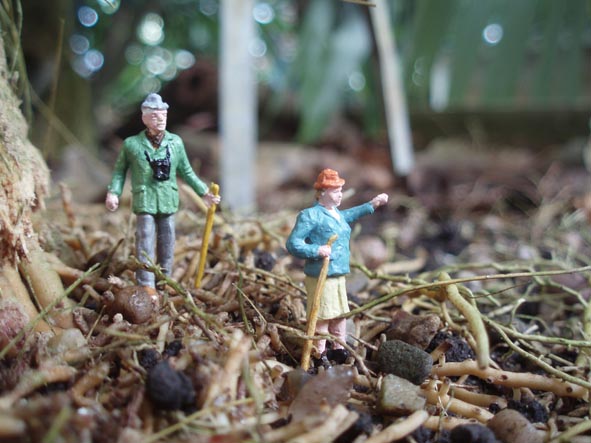
Little People is a street-art project in which a London artist hides tiny little model people up all over town, often in little scenes. It's brilliant.


